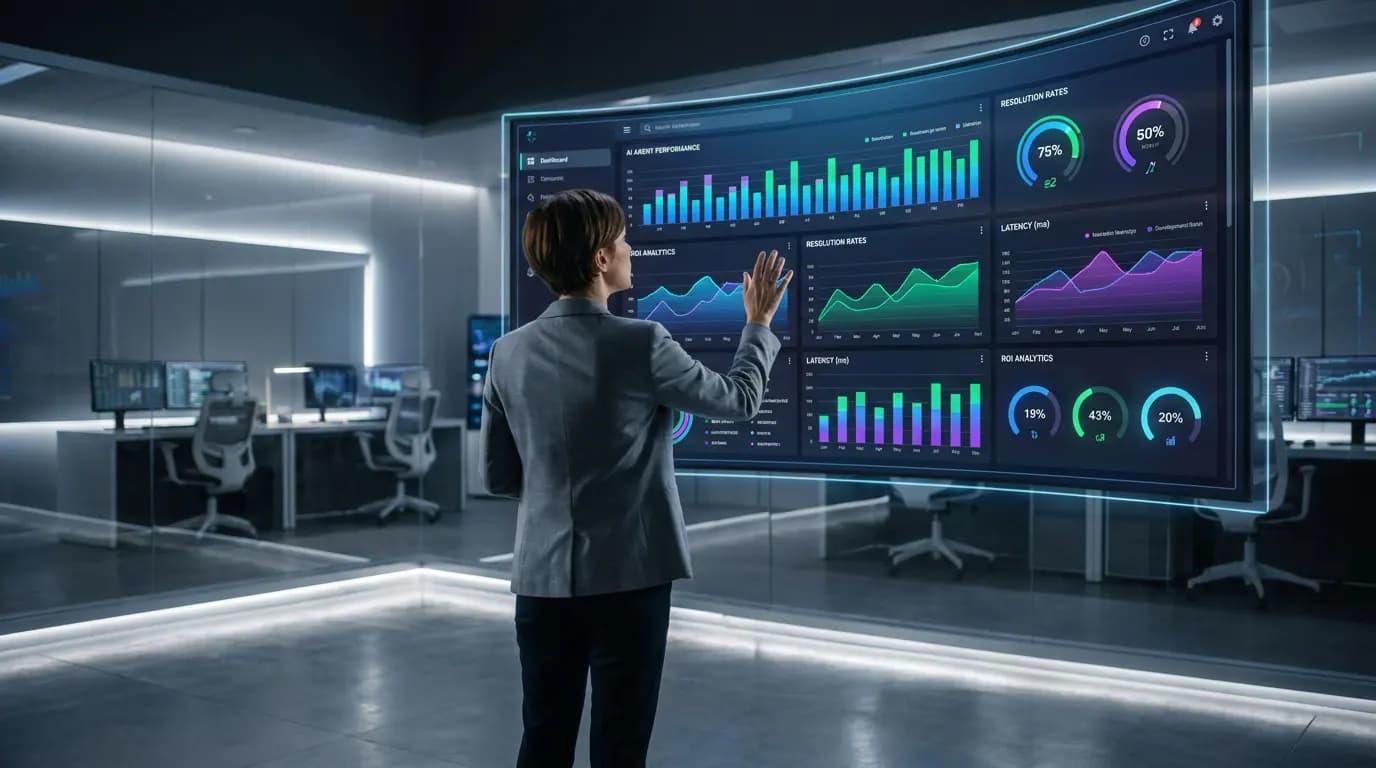
Managing a conversational agent isn't something you improvise: an autonomous resolution rate above 70% is now the performance standard for validating your immediate return on investment.
Yet without a clear read of your data, you risk flying blind between excessive call transfers and latency that degrades the customer experience. Let's break down together the strategic indicators on your AI agent performance dashboard to turn your interactions into concrete growth levers.
Managing your AI agent's performance with operational indicators
Managing an AI agent hinges on the autonomous resolution rate, often above 70%, and a drastic reduction in transfers. These metrics, correlated with technical latency, validate immediate operational ROI by driving the agent's autonomy.
The fully autonomous resolution rate
Analyzing the share of requests handled with no human intervention is essential. This KPI reflects the AI's ability to close a ticket. It's the flagship indicator for measuring the effectiveness of your initial setup.
Identifying the categories of requests that are most automated is instructive. Recurring questions about pricing or hours are usually the first to be resolved. This frees your teams from repetitive tasks.
Assessing the direct impact on customer service availability is essential. An agent available 24/7 guarantees an instant response. Customers no longer wait, which improves their overall satisfaction score.
Autonomous resolution rate
Often above 70% for high-performing centers.
Availability
Round-the-clock service with no downtime.
Response time
Typically targeted at under 2 seconds for AI.
Which KPIs should you track on your AI agent dashboard? The answer starts with this measurable autonomy.
The AI agent's autonomy isn't an end in itself — it's a lever for refocusing your experts on high-value cases.
What's your autonomous resolution rate?
Compare your AI agent's performance with market standards.
Market average: 72 %
High-performing
Your agent is highly effective and handles most requests with no human intervention.
Fine-tuned management of transfers to your teams
Tracking the volume of handoffs to a human advisor is vital. A transfer rate that's too high can signal a data gap. Conversely, a rate that's too low can frustrate customers.
Determining the recurring reasons for escalation to a human helps you improve. Is it a complex technical question or an emotional request? Analyzing these breakpoints lets you continually refine your conversational agent's knowledge.
Measuring the quality of qualification before transfer ensures effectiveness. The agent must hand off a complete case file to the advisor. This saves the customer from repeating themselves. The time savings for support are real.
This optimization actively contributes to the evolution of support roles within your company. Contact Moustache AI for a personalized demo of our monitoring tools.
Assessing the quality and accuracy of conversational interactions
Beyond volume figures, it's the surgical relevance of the answers that builds your users' trust.
Fidelity to context and internal data
Check that responses align with your knowledge base. The agent must draw exclusively from your official documents. That's the principle behind sovereign AI. This avoids dangerous fabrications that could damage your brand image.
Measure the absence of hallucinations. A wrong answer is worse than no answer at all. Regularly reviewing logs ensures this reliability, which is essential in a B2B environment.
Analyze the tone used against your brand guidelines. The agent should sound like your brand. Consistent formal address reinforces your French company's identity.
Your tool's performance rests on full control of your data. This guarantees your team reliable, secure information.
Identifying breakpoints in exchanges
Spot the stages where users drop off. A sharp drop in engagement often reveals too long a funnel. Simplify the journey to keep customers engaged.
Analyze the AI's semantic misunderstandings. Identifying these gray areas lets you fine-tune your prompts. It's necessary, iterative work to reach operational excellence.
Uncover the gaps in your sources. If the AI comes up empty, your documentation is incomplete. Use these failures to enrich your internal knowledge base.
To know which KPIs to track on your AI agent dashboard, monitor these friction indicators:
- Drop-off rate by step
- Unrecognized keywords
- Unanswered questions
Mastering technical indicators and user engagement
Content quality isn't enough if the technical infrastructure can't keep pace with your business needs.
Response latency and technical availability
You need to track your conversational agent's average response time. A reply should arrive in under two seconds. Beyond that, users tune out. Fluidity is the key to a successful experience.
Monitor the success rate of calls to connected tools. If your agent queries a CRM or an ERP, that connection needs to be stable. A technical failure breaks the automation process. Watch for these errors on your dashboard.
Guarantee a smooth experience with no excessive wait times. Moustache AI's European hosting delivers short response times. That's a concrete advantage over solutions hosted across the Atlantic.
| Indicator | Critical Threshold | Performance Target |
|---|---|---|
| Latency | > 3 seconds | < 2 seconds |
| API success rate | < 95% | > 99% |
| Server availability | < 99% | 99.9% |
| Widget load time | > 2 seconds | < 1 second |
Contact volume and click-through rate
Measure how your employees or customers are adopting the tool. A growing volume signals stronger trust. It's a sign the agent has become a go-to for quick information.
Analyze the effectiveness of the links the AI agent suggests. The click-through rate on shared resources is an excellent indicator. It proves the AI doesn't just talk — it effectively guides users.
Compare usage across your different communication channels. Web, mobile, or voice: where are your users? This analysis helps you prioritize your future technology investments.
Discover how to optimize your strategy by understanding the evolution of agents in 2025. To manage your project with confidence, request a personalized demo from Moustache AI.
Turning monitoring data into strategic decisions
All these metrics only matter once they're used to validate your digital transformation strategy.
The correlation between AI usage and time savings
Estimating the reduced workload for your teams is a priority. Precisely calculate the number of hours freed up each month. This figure remains the most persuasive one for your operational managers. It justifies the human investment in the project.
Calculate the average time saved per request handled. Multiply that gain by the total volume of conversations. You then get a concrete measure of the operational efficiency regained through automation.
Highlighting operational ROI for senior management strengthens the project's credibility. Don't just talk about technology — talk about productivity. Show how AI absorbs activity spikes with no additional hiring.
An AI agent's return on investment is measured by the renewed peace of mind of your support teams.
Benefits
- Significant time savings
- Immediate, quantifiable ROI
- Smooth handling of activity spikes
- Greater peace of mind for teams
Challenges
- Regular prompt adjustments
- Constant GDPR monitoring
- Dependence on data quality
Adjusting prompts and maintaining sovereignty
Defining a results-based optimization method is essential. Use negative feedback to correct the AI's instructions. It's a continuous improvement cycle that ensures your solution's performance.
Ensuring performance analytics comply with GDPR is a non-negotiable requirement. Your statistics should never expose personal data. At Moustache AI, we ensure local, secure processing. Sovereignty is at the heart of performance management.
Maintaining technological independence through European hosting protects your assets. Don't rely on foreign clouds for your strategic reports. Keep control of your digital assets and business know-how.
To secure your rollout, we invite you to request an AI Impact Assessment from our experts.
Managing your AI agent performance dashboard lets you turn technical autonomy into concrete profitability. By monitoring resolution rate and latency, you free your teams for strategic work. Act now to optimize your prompts and secure immediate operational ROI. Your conversational excellence starts with rigorous analysis.
FAQ
What performance indicators are essential for managing my AI agent's operational effectiveness?
To measure your solution's real performance, you should prioritize the fully autonomous resolution rate, which shows the AI's ability to close a ticket with no human intervention. It's also crucial to track the volume of transfers to your teams and analyze the reasons for those escalations to continually refine your agent's knowledge base.
Effectiveness also comes down to controlling cost per successful task and reducing the number of manual steps eliminated. By monitoring these metrics, you validate immediate ROI while freeing your team from repetitive tasks so they can focus on high-value cases.
How do you assess the quality and reliability of the agent's conversational interactions?
The surgical accuracy of responses is the foundation of user trust. You need to measure the absence of hallucinations and how faithfully the agent sticks to your sovereign internal data. Analyzing breakpoints, such as the drop-off rate by step or unanswered questions, lets you pinpoint exactly where the customer journey needs to be simplified or enriched.
Customer satisfaction score (CSAT) and the acceptance rate of proactive responses are key indicators of tone relevance and service quality. A high-performing AI must not only answer correctly but also carefully follow your brand voice and identity.
What technical metrics should you monitor on your dashboard to ensure a smooth experience?
Technical responsiveness is critical: you need to track response latency (ideally under two seconds) and the success rate of calls to connected tools, such as your CRM or ERP. A stable p95 latency guarantees that the vast majority of your users get consistent fluidity, avoiding drop-offs during the exchange.
Also monitor technical availability and your APIs' error rate. A high-performing dashboard should display these tolerance thresholds to prevent any analysis paralysis and ensure the infrastructure keeps pace with your business needs.
How do you measure AI's impact on productivity and the sales cycle?
Business impact is measured by faster time-to-market and a shorter average sales cycle. By automating prospect qualification, the AI agent drastically cuts the time needed to gather strategic information, which directly affects total revenue generated or influenced.
We recommend estimating the number of hours freed up each month for your support teams. This figure, correlated with the growing volume of conversations handled, demonstrates the AI's ability to absorb activity spikes with no additional hiring, restoring operational peace of mind.
What visualization formats should you favor to analyze your agent's performance?
For strategic management, your dashboard should include month-over-month trend charts and predictive views of your sales pipeline. Using tables that break down performance by acquisition channel (LinkedIn, web, mobile) is essential for prioritizing your future technology investments.
Adding filters by time period enables deeper analysis of the trends identified by the AI. These proactive insights, presented in a modular way, turn your raw data into real decision-making levers for validating your digital transformation strategy.