
June 28, 2025 marks a decisive deadline with the European Accessibility Directive coming into force, imposing strict standards for all digital services.
Yet bringing your interfaces into compliance remains a technical and human challenge that exposes your company to real financial penalties. We'll break down how AI and digital accessibility work together to automate your audits and enrich the user experience without compromising your security. Let's look at these levers of inclusive performance together.
AI for Digital Accessibility: Your Legal Obligations
The RGAA and the European Accessibility Act require strict compliance by 2025 for companies with more than 250 employees. AI speeds up the audit, but human validation remains mandatory to avoid financial penalties. This rigor starts with understanding the reference texts.
The RGAA Framework and the European Directive
The Référentiel Général d'Amélioration de l'Accessibilité (RGAA) is the essential technical foundation in France. It defines the compliance criteria for all your web interfaces, whether public or private.
The European directive now harmonizes these requirements across the Union. Companies must meet specific deadlines to guarantee the accessibility of their services. This regulation unifies standards for all economic players.
Anticipating these structural shifts requires constant regulatory monitoring. You need to stay informed to adapt your digital tools.
The Risks of Non-Compliance for Your Business
Administrative penalties are a real threat to your cash flow. A fine of €25,000 can be charged per non-compliant digital service. This is a major financial risk you can't afford to ignore.
Excluding 15% of the population seriously damages your brand image. Inclusion is now a decisive factor in how customers choose who to work with. Your reputation depends on your ability to welcome every user.
Advocacy groups can bring legal action. Rigorous compliance durably protects your organization against these lawsuits.
Test Your Knowledge of Digital Accessibility
Question 1 of 4
What is the major deadline for European compliance under the European Accessibility Act?
Anticipating Audits Through Automated Analysis
AI analyzes the source code to spot missing tags or heading-structure issues. It quickly identifies technical errors before an expert steps in. This early detection makes your developers' work much easier.
Smart tools automate the creation of detailed reports for your accessibility statement. They list friction points and suggest immediate fixes. You save valuable time in your regulatory preparation.
To secure your approach, don't hesitate to book your AI Impact Assessment now. Moustache AI helps you achieve compliance with peace of mind.
4 Benefits of AI for Your Text and Visual Content
Beyond mere technical compliance, artificial intelligence acts as a powerful lever to enrich the user experience every day.
Generating Alt Text for Your Images
Artificial intelligence instantly analyzes your visuals to identify objects and actions. It understands the image's overall context. It then generates precise text descriptions for your "alt" tags.
This technology is vital for people using screen readers. Without this text, the image simply doesn't exist for a visually impaired user. AI thus ensures equitable transmission of visual information.
SEO also benefits from this precision. Search engines index your well-described visual content more effectively.
Automatic Transcription and Captioning for Videos
The speech-to-text conversion process turns your audio tracks into written text. AI perfectly syncs every word with the video stream in real time. This automation cuts production costs. It's a major help for your hard-of-hearing customers.
Automatic captioning makes your video content accessible to 100% of your audience, even without sound.
A human review is still recommended for complex proper nouns. AI handles 95% of the initial workload, though.
Simplifying Text Into FALC, an Easy-to-Read Format
FALC — Facile À Lire et à Comprendre, or "Easy to Read and Understand" — aims for absolute clarity. This method simplifies vocabulary and sentence structure. AI handles this rewriting with remarkable efficiency.
This approach helps people with cognitive disabilities or DYS disorders. Understandable information reduces user frustration. The reader grasps the essential message without unnecessary mental effort.
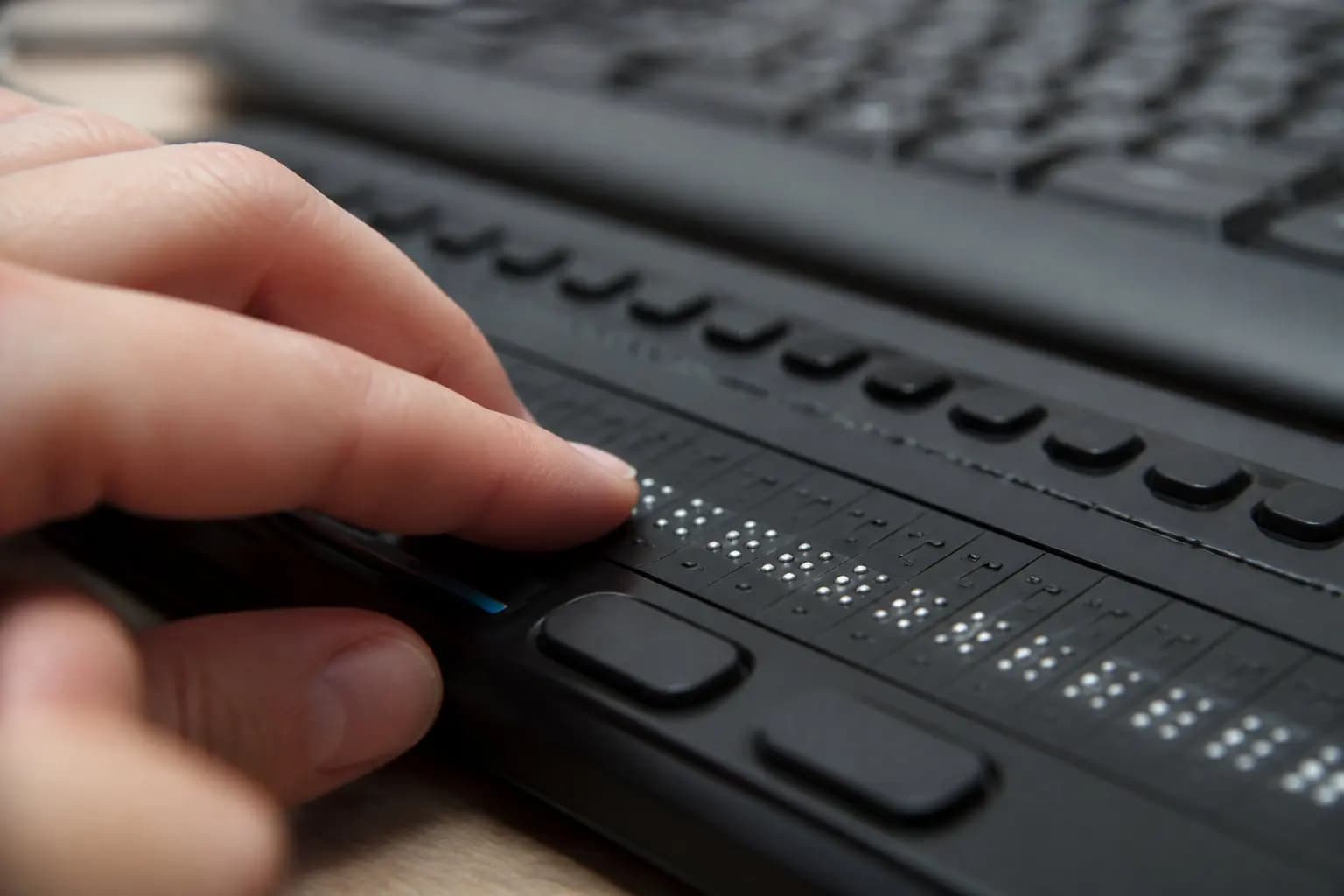
You can discover how to integrate these tools into your AI-driven digital transformation to optimize your business processes.
Dynamically Fixing Contrast and Readability
AI can automatically adjust your web interfaces. It changes colors to meet current legal contrast ratios. These adjustments adapt to the specific preferences your visitors set.
Typographic readability also benefits from these algorithms. Text enlargement and font changes happen dynamically. Visual comfort is maintained across all reading devices.
How does AI improve your website's digital accessibility? By turning these technical constraints into a smooth experience for everyone. Moustache AI helps you deploy sovereign, accessible conversational agents. Contact us for a personalized demo of our solutions.
How Conversational Agents Streamline Your Navigation
Even when content is accessible, finding it can still be a challenge — one that conversational agents handle brilliantly.
Reducing Cognitive Load Through Dialogue
Navigating complex menus often tires users out. Searching for specific information in a deep site structure quickly becomes tedious. A chatbot lets users simply ask a question. The answer arrives instantly, with no complex navigation required on your site.
This direct approach transforms the user experience. To better understand these tools, discover the differences between a conversational agent and a chatbot. You'll gain operational clarity.
The conversational interface radically simplifies the customer journey. It's a real asset for older users.
An Effective Alternative for Visually Impaired Users
Adding voice changes everything. A voice agent guides users through your services. It replaces the tedious reading of long paragraphs with efficient text-to-speech, to great effect.
Direct dialogue also bypasses structural obstacles. Some websites have keyboard-navigation bugs. AI avoids these pitfalls by getting straight to the information the user needs.
Using an AI voice agent automates your interactions. This guarantees constant accessibility.
Inclusive User Support and Round-the-Clock Availability
24/7 availability is a pillar of inclusion. Users with specific needs browse at all hours. AI responds with the same patience and consistent accuracy to every request.
The quality of the exchange stays consistent, unlike with a tired human agent. AI never judges and repeats information as many times as needed. It's a major reassurance factor for your audience.
Conversational AI guarantees fair, seamless support for every user, regardless of disability.
The Smart Handoff to a Human
AI precisely detects when a situation becomes complex. It identifies specific emotional or technical needs. It then hands the case off to an advisor along with all the necessary context.
This continuity of service is essential. The user doesn't need to repeat their initial problem. The handoff happens smoothly, avoiding any frustration or drop-off.
Check out our Moustache AI customer stories. You'll see concrete examples of successful deployments.
The Limits of Automation and the Role of Human Expertise
Still, AI is no magic wand; its effectiveness depends closely on human oversight and ethics.
The Risks of Algorithmic Bias
Consider context errors. An AI can misinterpret a complex image or an ironic tone. These automatically generated descriptions can mislead the user. Vigilance is therefore essential.
Guard against misinterpretation. Language models can sometimes hallucinate or oversimplify. Incorrect content is worse than no content at all when it comes to accessibility.
| AI Task | Identified Risk | Human Solution |
|---|---|---|
| Captioning | Syntax errors | Editorial review |
| Alt text | Visual misreading | Contextual validation |
| FALC simplification | Loss of nuance | Semantic arbitration |
| Voice navigation | Logic loop | Journey audit |
The Importance of Testing With Real Users
Validate solutions through real use. Nothing replaces testing your interface with a blind user. Concrete feedback reveals blocking issues that are invisible to algorithms.

Adopt a human-centered approach. AI should adapt to real needs, not the other way around. User testing helps fine-tune the conversational agent's settings. It's a guarantee of final quality.
You can discover how we apply these principles by checking out our customer stories. This field feedback ensures effective, lasting inclusion.
Ethical AI Governance in Your Company
Put systematic human oversight in place. Automated content should be validated by an accessibility manager. This governance ensures the reliability of the information published across your channels.
Ensure algorithmic transparency. Users should know they're interacting with an AI. Explaining how data is processed builds trust. It's a pillar of modern digital ethics.
So there you have it: technology becomes a powerful lever when it serves an inclusive vision. Your social responsibility shows through this balance between technical innovation and human vigilance.
Why Choose Native Accessibility Over Overlays?
For these tools to be truly effective, they need to integrate into a healthy structure, rather than trying to mask design flaws.
The False Promises of Accessibility Overlays
These external toolbars often clash with users' screen readers. They slow down the site without fixing the underlying code. It's a superficial, ineffective solution. The real problem stays hidden.
No widget can magically make a site 100% accessible. Courts are already starting to penalize these misleading technological shortcuts. The illusion of compliance no longer protects your company from legal risk.
Inclusive Design From the Start
Build standards in from the start. Clean code is naturally accessible. This design-first approach cuts maintenance costs over the long run. You avoid costly, laborious redesigns down the road.
Embrace universal design. Designing for disabilities actually benefits all your users. A clear, well-contrasted interface improves overall usability. It's a winning strategy for your conversion rate and your brand image.
Check out our tips on how to build a conversational AI that respects these standards. How much AI improves your website's digital accessibility depends above all on the quality of its initial structure.
Ongoing Maintenance and Updates for Your Interfaces
Track how your content evolves. A website is alive and changes every day. Accessibility has to be maintained with every update so it doesn't regress. Human vigilance remains the cornerstone of your digital strategy.
Use AI as a productivity assistant. It can alert developers at commit time if a new page isn't compliant. It's a valuable technological safety net for your technical teams day to day.
Accessibility is a marathon, not a sprint. Regular automated audits ensure your efforts last. At Moustache AI, we believe sovereign technology should serve everyone, without exception.
Data Sovereignty and Choosing Your AI Tools
Finally, accessibility should never come at the expense of your users' security and privacy.
The Risks of Non-European AI Solutions
Raising awareness about data transfers outside the EU is essential. Using American tools exposes your vulnerable users' data to the Cloud Act. Privacy is then compromised.
Identifying the dangers to users remains critical. People with disabilities sometimes share sensitive information. Protecting them must be an absolute priority for your IT department.
Check out our guide on sovereign AI: taking back control of your security.
Native GDPR Compliance and Local Hosting
Choosing sovereign conversational agents is a strategic move. Hosting on European soil guarantees strict GDPR compliance. It's a mark of credibility with your institutional partners.
Guaranteeing information security requires local infrastructure. Data flows must be encrypted and processed locally. This limits the risk of leaks or unauthorized commercial exploitation.
Discover our commitments regarding business AI data security for your company.
Independence From US Players
Choosing French technology partners guarantees your autonomy. Controlling the entire processing chain secures your independence. You're no longer at the mercy of arbitrary pricing or terms-of-service changes.
Supporting the local ecosystem is a growth lever. Choosing a French AI provider like Moustache AI strengthens national digital sovereignty. It's a strategic choice for the longevity of your tools.
Criteria for Choosing a Trustworthy AI Provider
Checking security certifications is the first step. A trustworthy provider should have clear commitments on data protection. Assess their ability to support you over the long term. Accessibility is an evolving project.
So, we invite you to request a demo from Moustache AI for your projects.
AI and digital accessibility turn your interfaces into concrete levers for inclusion, thanks to the automation of alt text, captioning, and FALC simplification. Get ahead of the 2025 legal deadlines now to ensure a smooth, sovereign user experience. Build a universal web today, where every interaction becomes a barrier-free opportunity.
FAQ
How Can Artificial Intelligence Strengthen My Website's Accessibility?
Artificial intelligence acts as a compliance accelerator by automating complex, time-consuming tasks. It can generate alt text for your visuals, produce automatic captions for your videos through speech recognition, and dynamically fix visual issues such as insufficient contrast.
Beyond the technical side, AI improves the user experience by simplifying dense text into FALC (Facile À Lire et à Comprendre, or "Easy to Read and Understand"). This effectively includes people with cognitive or reading difficulties, turning your interface into a truly universal space.
What Are the Legal Obligations for Digital Accessibility in 2025?
The major deadline is June 28, 2025, with the European Accessibility Act (EAA) coming into force. This directive harmonizes requirements at the European level and requires companies to comply with the EN 301 549 standard. In France, RGAA 4 remains the reference technical standard for assessing your compliance.
Your organization must publish an accessibility statement and establish a multi-year compliance plan. Failing to meet these obligations exposes your company to significant financial penalties, which can reach €25,000 per non-compliant service — not to mention the major impact on your brand image and social responsibility.
Can a Conversational Agent Really Make Navigation Easier for Users With Disabilities?
Absolutely. An intelligent conversational agent offers a smooth alternative to navigation menus that are sometimes overly complex. By enabling direct dialogue, it considerably reduces the user's cognitive load. For a visually impaired person, voice interaction effectively replaces the tedious reading of long paragraphs with precise text-to-speech.
These tools guarantee 24/7 availability, offering patient, judgment-free support. However, to be a real lever for inclusion, the chatbot itself must be designed to accessibility standards, particularly for keyboard navigation and screen-reader compatibility.
Can AI Fully Replace a Human Accessibility Audit?
While AI is a valuable ally for automatically detecting code or markup errors, it doesn't replace human expertise. A machine can misread the context of an image or the tone of a text. An expert's eye, along with testing by real users with disabilities, remains essential to validate the relevance of the solutions deployed.
We recommend a hybrid approach: use AI to handle 95% of repetitive tasks and large-scale data analysis, while maintaining human governance to oversee generated content. This complementary approach guarantees full reliability and impeccable digital ethics.
Why Should I Avoid AI-Based Accessibility Overlays?
Overlays, or "widgets," often promise magic one-line-of-code compliance, but that's a technical illusion. These tools frequently conflict with the assistive technologies (like NVDA or JAWS) used by people with disabilities. They slow down your page load times without ever fixing the errors at the source, in your code.
Choosing native accessibility, built in from the design phase, is the only sustainable strategy. Unlike overlays that mask problems, inclusive design from the outset ensures technical robustness and avoids the legal risk of penalties for a "compliance illusion."
How Can I Guarantee Data Security When Using AI Tools for Accessibility?
Data sovereignty is a pillar of digital trust. To protect your users' sometimes sensitive information, it's crucial to choose AI solutions with GDPR-compliant European hosting. This protects you against data transfers outside the EU and the risks tied to the US Cloud Act.
By choosing a sovereign technology partner like Moustache AI, you ensure that data flows are encrypted and processed locally. This secure approach strengthens your strategic independence while offering local technical support specialized in the accessibility needs of the French market.